Friday, June 1, 2012

Tiberius Gracchus, the first land reform and the fall of a republic


When Tiberius Gracchus was elected as the representative of the Roman Senate in 133 B.C., nobody knew that the fall of the five hundred years old Roman Republic, which would inspire the European intellectuals and the American Constitution with its parliament and administration thousands of years later, will start and the Republic would turn into a dictatorship, the Roman Republic would come to an end and the Roman Empire would be founded. Tiberius suggested that some land of the rich Roman people were taken and distributed among the landless, and thus, he started the first land reform. The political rebellion he initiated would finish a republic and create a socialist concept that would influence the people for thousands of years. Tiberius was killed by the rich land owner senate members whose interests he threatened.


Tiberius Gracchus and his brother Gaius Gracchus,
who was killed just like Tiberius as he adopted
the land reform after Tiberius’s death, are holding
the land reform code together  in their hands
(Eugene Guillaume, 1878)
 His full name is Tiberius Sempronius Gracchus, but we’ll call him as Tiberius here. He was born in 163 B.C., as the middle son of a significant politician and soldier, Tiberius Cracchus and African Cornealia. It is possible to define his family as quite rich and “noble”. Tiberius’s father, who had died when Tiberius was a small child, had a great deal of land.  
Tiberius was a soldier like his father. He was sent to the Spanish front after his success in Carthage war. But things didn’t go well in Spanish front. The army was destroyed by the Spanish. He had two choices then. To fight and lose many people and withdraw or to save his army through a peace treaty and return back… He chose the second. He saved the lives of 20.000 soldiers. He signed a peace treaty and turned back to Rome. But his humanistic act was not approved, and he was expelled from the army on the grounds that the Roman Army would never sign a peace treaty with barbarians. Then, he entered politics.  

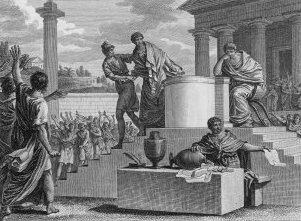
Octavius being pulled down the rostrum by Tiberius
(Augustyne Mirys, 1760)
 When he was elected as the representative of the Senate in 133 B.C., he suggested that the public lands which were actually owned by the state but used by the rich senate members, were distributed among the poor within the framework of some rules (“Lex Sempronia Agragia”). This suggestion was accepted in the voting thanks to the support of the republican people party. The soldiers were also supporting Tiberius. Because when they went to military expeditions that lasted for long years, they found their lands invaded by the rich land owners, and they became landless when they returned back to Italy. Tiberius’s law would make them land owners again. The law, which made the people very happy, was not welcomed by the land owner senators.
As the support of the common people behind Tiberius intensified day by day, the number of his enemies in the “State” increased. The senate was divided into two as the reformists leaded by Tiberius, and the conservatives leaded by Marcus Octavius. Tiberius succeeded in sending Octavius away from the head of the conservative party claiming that Octavius was hindering the senate by misusing the veto right. He did this in a senate meeting, in front of everybody, by using force. You can find a quite detailed description of this tragic and significant event, Octavius’s leaving the rostrum in tears, the rich senators behind him, in Greek historian Plutark’s book titled as “Lives”, where he wrote about Tiberius’s life.
Tiberius addressing to farmers
To become elected again at the end of his one year of  duty term, he promised to submit a draft regulation offering that the spoils of war brought from the Bergoamon  Kingdom invaded by the Romans  were used to finance the land reform, the duration of military service was shortened, the right of being a jury in courts which exclusively belonged to the senate members before, was given to everybody and the “foreigners” living in the land invaded and who did not have a citizenship right were accepted to be Roman citizens. If he was to be elected again, Tiberius’s reforms wouldn’t be limited to land reform. He promised democratization in other areas, as well.
Gaius Garcchus’s death
(Francois Topino-Lebru, 1792)
There was an extraordinary tension in the senate on the day of the voting for Tiberius. One of the senators shouted that he wanted to be declared as the king. Havoc rose. Despite the presence of his supporters waiting out, Tiberius was beaten by the land owner conservative senators and killed. Upon his death, his brother Gaius followed his way and wanted to continue the reforms, but he was killed by the rich land owners just like his brother.
The land reform trial attempted by Tiberius brought the end of the Roman Republic and Senate, which was still trying to manage such a great country that had reached an enormous size due to the colonies it had established and its extending policy and the great incomes of this country through the laws of a small city-state. The act started by Tiberius caused a common disturbance and an approximately one hundred years of civil war. Soldiers such as Cornelius Sulla and Julius Cesar terminated the senate with coups and finally, Gaius Julius Agustus announced the foundation of an empire that would last till 1453, and he had it irrevocably institutionalized.
Tiberius’s land reform brought about two important questions that would occupy the mind of humanity for the following two thousand years:
Should the state distribute the lands of rich land owners to poor farmers? Do the ones living on a land, and cultivating it have the right of ownership on that land?
2010 A.C., Indonesian farmers are walking for the land reform 

Emperor Julian (Julian, The Apostate), The Last Pagan


Julian’s statue in Louvre Museum
Julian (Flavius Claudius Julianus) was born on 30th April 332 in Constantinople as a member of the Constantinian Dynasty which was the first Christian dynasty of the Roman Empire. After an empery that lasted 18 months from 361 to 363, he was wounded in a war and  he died as the last Pagan emperor of the Roman Empire. His parents were Christians. In his youth, he was brought up by the significant bishops of the age, Eusebius and Mardonius in Nicomedia (today’s Izmit) and Cappadoccia churches. Yet, he accessed to classical books on philosophy through his own efforts. He went to Athens when he was twenty three years old and adopted the neo-Platonist paganism. He interrupted the Roman Empire’s process of conversion from Paganism to Christianity that started as of 2nd century and became official in 330 when the Emperor Constantine the 1st became Christian for the first time; and brought it back to Paganism. Julian’s struggle against Christianity made the church and the court angry, thue he made a great deal of enemies as a result.


Year 312- The Emperor Constantine
sees the figure of cross in the sky one night before
the Milvian Battle  and switches to Christianity from Paganism
Constantine’s Apostasy (Rubens, 1622)


In 355, Julian was assigned as the vice emperor for the Western Regions by his uncle Constantius. After the battles he won in Gaul in 357, he was declared as the emperor by his army in 360 in Paris. Then, he headed towards the East to fight against his uncle Constantius, who had been in Antioch. But his uncle suddenly got sick and died, so Julian gained the throne without the need of a civil war. He fought against the Persian Empire, which had been the most significant threat to Rome at that age. He had his headquarters in Antioch for about a year and managed the empire from there, as well. He got wounded in a war against the Persians in 363 and he died a few days later. Some claim that he was killed by a Christian soldier in his own army, not by an enemy.
He frequently created tension among the local people due to the limitations he exposed on the church in Antioch, which was a vigorous Christian city of the time. In his piece named as “Misogopon” (The Beard Hater), he wrote for the blue nosed Antioch people who were determined not to convert back to Paganism again, he told about his struggle against Christianity, the beauties of Paganism, classical philosophy and intellectual enlightenment. Between the lines, one can see his anger and disappointment with the Antioch people.

Saint Mercurius believed to have killed Julian
and saved Christianity

 “Why don’t you still give up remembering Mary as the Mother of God? What would you say if Christ came today and told “I was born from the Virgin as the first and dear man of the God, I am the first of the creatures”?
Julian, Misopogon, 362 Antioch
At those times, the classical philosophy supporters who believed in pagan religions and wished to turn back to ancient periods grew beards like the ancient philosophers as a “political symbol”. On the other hand; new current Christians got shaved. The name of his book, “beard-haters” stemmed from that. So, we see that humanity has not changed much; even 1700 years before, people could be modern or blue nosed with hair and beard. Anyway, let’s turn back to our subject; Julian was brought up by the bishops, Eusebius and Mardonius. He got a strict religious education and worked in the church when he was eighteen. So, he knew the Old and New Testaments quite well. This is why his criticism of the community he had once been a part of was so strong. In his book he told that; after having lived as a Christian for the first twenty years of his life, he chose the true way, the way of the God of Sun, Helios, which was Paganism. ( I would like to have your attention to the beauty of Bronnikow’s picturea and the similarity of the Pagan priest with Christ.)

Pagans worshipping to Helios, i.e. the Sun, like Julian.
(Pythagoreanists Are Celebrating the Sunrise, Fyodor Bronnikov, 1869)
In Constantinople, where he had stayed as an emperor for 5 months before going to Antioch, he had tried to decrease bureaucracy and fix the state issues he thought to have been managed in an inefficient, expensive and unfair way. Various sources claim that he considered himself as the “primus inter pares” i.e. “the first one among the equivalents” rather than as a noble emperor not caring for his people and senate; he negotiated with the senators rather than dictating laws. As well as being referred as “Julian, The Apostate” as he converted to Paganism from Christianity, he is also referred as the “Philosopher Julian” thanks to his fascination with classical philosophy. I think Julian resembles the “Philosopher Emperor” Marcus Aurelius, one of the prior emperors whose articles on life and ethics were published under the name “Meditations”. Both devoted themselves to classical philosophy and realized Plato’s idea of hundreds of years old: “either philosophers shall be statesmen or statesmen shall be philosophers”. I believe they were two rare men possessing two rare characteristics; intellectual richness and management skill. Despite all these good sides, Julian is seriously criticized for his elitist and despot character. He always saw the elitist pagans superior than the poor and uneducated Christians. He forced paganism to the public. But that was the very reason why Christianity attracted supporters those times. Julian’s elitist philosopher and despot sides came into life as the “Enlightened Despotism” in Europe in the 18th century. Katrina the 2nd in Russia, Joseph the 2nd in Austria, Louis the 7th in France all believed in the rationalism and enlightenment today’s western civilizations are established upon, and imposed this to their people. That the two distant words of enlightenment and despotism come together throughout the history is one paradox of humanity. That unfortunately seems to mean that progress cannot be realized without despotism.
His graveyard found in the garden of Istanbul Archeology Museum
When Christian Jovian came to the throne after him, his first act was to regain the church’s privileged position and consequently Roman Empire became Christian irrevocably. It is claimed that his last words before he died were “You won Galilean (Christ)”. Ancient time pagans called the first Christians as Galileans. Galilean Judas and his friends were Judas rebels who rejected giving tax to the Romans, who ended up with death. One cannot help but think what would happen if this ancient Don Quixote who was an intellectual and a good (and a little despot) statesman was able to become successful in converting Roman Empire into paganism. Would the humanity not ever experience the middle ages?

John Palaiologos the 8th and Florence 1439 Catholic Oecumenic Council

John Palaiologos the 8th , During his visit to Florence.
Painting drawn by Benozzo Gozolli(1439)

The Palaiologos dynasty ruled the Byzantine Empire from 1260 until 1453, and they were in the saddle during the decline and collapse period. John Palaiologos was the emperor before the last emperor Constantine the 11th who was believed to have been killed on 29th May 1453 while fighting against Fatih’s (Mehmet the Second, the Conqueror) army on the ramparts. 
John Palaiologos the VIII. recovered from Murat the Second's invasion of Constantinople in 1422 without surrendering the city. Yet, against the ever increasing threat of the Ottomans, he went to Florence in 1439 and attempted for a conciliation to find support from the Catholic Church and Europe. In order to eliminate the dogmatic differences between Catholicism and Orthodoxy and to combine these two churches, the main issue discussed in the Catholic oecumenic council in Ferrera Florence to which 700 members participated in as well as Pope Eugene the VI., the Byzantine Emperor John and the Constantinople Patrician was “filioque”, i.e., the form and content of the “trinity” relationship of the Supreme Spirit, Jesus and the God.
1439 Ferrera Catholic Oecumenic Council
John Palaiologos signed the decision text of the council with Pope Eugene, to protect the kingdom (I think it would be more proper to call the Byzantine Empire as a small kingdom rather than an empire as of 1439) at the cost of ignoring the basic differences of Orthodoxy, though the intention of the Council wasn’t to reconcile but to bring down the trapped Byzantine Empire and Orthodox Patriarch. (There is the picture of the signed original of the document in Cyril Mango’s book titled as The Oxford History of Byzantine Empire) The “contract” which somewhat connected Orthodoxy to Catholic Rome and was signed by him in order to get the help of the Catholic westerners to protect his people and city against the Ottomans, was never valued by the eastern Orthodox churches. And the western world never sent the Crusades or the military aids they had promised for. They left the Orthodox Byzantine people to their destiny against the Ottomans.

At this point, the great struggle John Palaiologos gave despite the objection of his own church and people cannot be underestimated. Near the end of this trip to Florence, his wife Maria, who was from Trabzon, got sick and died. But John wasn’t told about that. In February, when he went back to Constantinople in February, the emperor learnt the truth, which was kept secret during the return back home made in December through the sea.
He died five years before his city surrendered in 1448. But due to the Florence council declaration, which both parties deemed invalid after its signing, he spent the rest of his life as a man accused by his own people and church of being a traitor. 14 years after the Council, in 29th May, the city surrendered. Yet, the military aid that had been promised to John by the Pope never set out.

Fethiye Mosque, Theotokos Pammakaristos Church

As most of its interior walls were destroyed to open place for the public, and remaining exterior side walls were scraped and painted; only a little part of it could survive. Despite these, it is the second Byzantine church possessing the highest number of mosaics after the Chora church and Hagia Sophia.
It's located in Fatih, Çarşamba, at the top of a hill looking down at the Golden Horn. One can go there on foot from the seaside, going up the Çiçekli Bostan Street; or from Adnan Menderes Boulevard, by walking on Akşemsettin Street towards the Golden Horn (http://g.co/maps/3x9aq). The full name of the church is Theotokos Pammakaristos. Theotokos  means “The mother of God  (The Mother Mary)”, Pammakaristos means “Superior, Almighty”.

Fethiye Mosque - Pammakaristos Church

There is conflicting data about the construction date of the Church. While some sources claim that it was constructed in XI. century by Michael Ducas the VI., some claim that it survived from the VIII. century. In a limited number of sources that could give the most certain date, Ioannes Kommenos and his wife Anna Doukina were claimed to have the church constructed in 1292. It is among the most significant pieces of the Late Byzantine, Palaiologos architecture.
Following Istanbul’s invasion by the Ottomans, it hosted the Greek Orthodox Patriarch from 1556 to 1586. In 1591, in the period of Murat the III., it was turned into a mosque and it was given the name “Fethiye Mosque” in memory of the conquests of Georgia and Azerbaijan. It was restored by the American Byzantine Institute in 1494. Today, the large part of the structure is used as a mosque and the small part, which was added in XIV. century as a chapel, is used as a museum. When Fatih (Mehmet the second) conquered the city, he assigned Gennadius as the patrich with a magnificent ceremony. Gennadius was a vigorous supporter of the Aristotelian philosophy who was an expert in western philosophy as well as theology. He worked there for nearly 6 years. Faith visited him frequently. The two negotiated on various issues for long times. Gennadius and Fatih formed the principles that would determine the position of Orthodox Greek within the Ottoman state.

The most significant and beautiful mosaic in the church is the one in the main dome, which depicts Pantokrator Christ and the 12 apostles of the Old Testament. Here, Christ is in the middle and the apostles surround him. It evokes a great admiration in people looking at it. In this mosaic, Christ was drawn as “Pantokrator” (it stemmed from God names and definitions like “Honorable” and “Almighty”  in Judaism and the translation of the Hebrew Bible into ancient Greek) which is among the basic concepts of the Christian iconography. The big Christ icon in Hagia Sophia is again in “Pantokrator” concept. Greek names of the 12 apostles of the Old Testament are written on their pictures, and the following are written in the texts they are holding in their hands:
 
Pantokrator Christ and the 12 apostles of the Old Testament

Isaiah - "Do you see? The God is above the clouds"
Oses - "Oh God, you are the creator of creators, the God of Gods”
Jeremiah - "He is our master. He cannot be compared with anything”
Zephaniah - "The world will burn with the fire of my jealousy”
Micah - "Our master’s home will rise above the hill”
Joel - " Don’t worry, the world will be a happy place again, thanks to the beauties crated by our master”
Zechariah - "Mountain of the master of the host”
Obadiah - "Will be safe on the hills of Jerusalem”
Habakkuk - "Oh, Master, I have heard your voice”
Jonah - "And my prayers reach you”
Malachi - "As I have said, I’ll send my apostles”
Ezekiel - "And when all living believers leave”
Apart from this mosaic, there is a big mosaic describing the baptism of Christ and the large and small mosaics on which saints are mostly portrayed.

Little Hagia Sophia Mosque, Saint Sergius and Bacchus Church


It is next to the railway when one goes down the Sultanahmet Square in Kumkapı. Other side of the railway is the coastal road and the sea. It is nearly 100-150 meters ahead when one takes the first left when going down the railway and through the tunnel to enter Kumkapı from Eminönü coast. (http://g.co/maps/emx4j).

Little Hagia Sophia Mosque, Saint Sergius and Bacchus Church

Emperor Justinianos and his wife Empress Theodora had it constructed in 536 in the name of Saint Sergius and Bacchus. Its architect is unknown but it is likely that it was constructed by the architects of Hagia Sophia, Isidorus from Miletos and Antemius from Tralles to whom it owned its Turkish name, as it had been constructed just before Hagia Sophia and resembled it so much regarding exterior appearance (its interior structure is quite different). Ignoring the differences in its internal structure, it is quite reasonable that it had been a preliminary “etude” of Hagia Sophia whose construction started five years later. In “Istanbul Travel Guide” Murat Belge told how “fertile” the interesting dome standing on a square-like base and the architecture of the church were: The plan of San Vitale Cathedral, which was famous for the mosaics Justianos had them made in Ravenna in 547 after his expedition to Italy is a one-to-one equivalent of the Little Hagia Sophia Church. Since the plan of Aachen Cathedral, which the Great Charl (Charlemagne) had it made in 805 was a true copy of San Vitale’s plan, it is the same as the Little Hagia Sophia. But more interestingly, the Selimiye Mosque constructed by the Architect Sinan in Edirne in 1574 also had the same plan with the Little Hagia Sophia. It is surprising that, the Aachen Cathedral and Selimiye Mosque, which were constructed in two distant corners of the World and which belonged to two different cultures derived from this small modest church, though they don’t resemble each other regarding exterior appearance.

Emperor Justinianos /
San Vitale Cathedral mosaics
Let’s look at the story of Saints Sergius and Bacchus, which is much more interesting than the church’s story in my opinion: Sergius and Bacchus were two senior Roman officers in the army of the Emperor Galerius Maximianus. They were secret Christians at first. But when they rejected participating in a ceremony in Jupiter temple, this was revealed. They were fettered and made wear women’s clothes and wander in the city in the first place. But they didn’t accept to convert from their religion. They lost their lives under great tortures and became religious martyr saints.
It was constructed in the garden of Homicides Palace, in which Justinianos had stayed before coming to the throne, and his step-brother, the Persian Prince Hormizd, who took shelter in Constantine in Constantinople stayed when he was taken prisoner by the Persian King, Sapura; and it took its name from that palace. One monastery was added to the structure in time, and together with Hagia Sophia, it became one of the most important religious structures of Constantinople.

Saint Sergius and Bacchus

Justinianos was born in Toresuim village (today’s Costanzia) in a plain peasant family. When he was young, he was imprisoned for the reason that he had attempted to conspire against the Emperor Anastasius (in some sources, this event is told to have passed between him and his uncle, Justin, but I don’t think it passed between him and his uncle, who was stated to have supported him all his life, but between him and the previous Emperor, Anastasius), but Anastasius forgave him and he went out of the prison. So, here is the story: Anastasius saw Saint Sergius and Bacchus in his dream at night. The saints told the Emperor that Justinianos was innocent and he forgave him the following day. This event was actually a milestone in Emperor Justinianos’s life. He went out of prison and narrowly escaped death. Then he became the emperor. But he wasn’t an ordinary emperor. As agreed by most historians, he became one of the greatest emperors of the late antiquity. When he died, he left the Hagia Sophia Church, which would possess the highest dome of the world for nearly 1000 years, the Roman Civil Code (Corpus Juris Civilus) which formed the base for today’s law and an empire which almost surrounded all the Mediterranean. According to the historian, Prokopius; the struggle he gave in order to get married to her “belly dancer” wife who had been a prostitute (in spite of all rejections, he removed the clause stating that “the emperor cannot choose a wife from a sub-class” from the Code), his life-long loyalty and love is an individual subject of writing. 
The extent of the “friendship” of these two fellow soldiers saints who were protectors of the soldiers in the army and who were especially taken up seriously by the Syrian and Arabic churches, was quite negotiated, and they were claimed to have an emotional bond beyond friendship. In the adjoining icon, they portrayed the saints rather meaningfully.


Let’s turn back to our church. The monophysites being exposed to pressure from all over the empire stayed in this Saints Sergius and Bacchus church under the protection of the Empress Theodora, who possessed the monophysite belief contrarily to her husband who was a Diophysite that adopted the Chalcedon (Kadıköy) Council decisions of 451 which were a milestone in Christian theology, most likely with the influence of the years she had lived in North Africa.

The status of the church remained the same for a while after the Ottomans conquered the city in 1453. In the period of Beyazıd the II., it was transformed into a mosque by the eunuch of the palace, Hüseyin. It was given the name; Little Hagia Sophia Mosque and the pictures and mosaics inside it were covered by paint. It was damaged in the earthquake experienced in 1600s.  The Grand Vizier, Hadji Ahmet Pasha had it repaired in 1740 and its first minaret was added in 1762.  Its biggest problem today is the vibrations created by the local train passing nearby. 
As it is still used as a mosque, there aren’t any mosaics or pictures inside it. But one can tell from the marbles of its columns and the magnificent column capitals that, it came from a totally different time, it had been a unique and such a beautiful thing before. The delicacy and beauty of the stone work is fascinating. You can’ t help but imagine its days in Justinianos and Theodara’s times, when it was ornamented with colorful mosaics from the ground to the ceiling like Chora Church.

Blachernae and Tekfur Palace, Porphyrogenitos Palace

Blachernae is the name of the neighborhood located in northwest, within the Theodosian Walls of Constantinople. In the urban plan (Notitia Urbis Constantinopolitanae)  made in the period of Theodosius II., which divided the city into 14 parts including Galata and which showed the important structures on them, it was referred as the 14th district. Today its name is Edirnekapı, Fatih.
Notitia Urbis Constantinoplitanae

When Theodosian Walls were built in 4th century, Blachernae was included inside these ramparts like Chora Church which meant “located outside the ramparts, in suburban, rural areas” and became a part of the city. In times it was outside the Constantine Walls, it was probably an active place as you could guess from the Chora Church nearby. A spring came out of the skirts of this hill, near which the Byzantine Princess Pulqueria had a church (The Mother Mary Church found in today’s Mustafa Paşa Bostanı Street) constructed in 4th century. Its waters were believed to have a healing effect. Orthodox people now believe that these springs are sacred. We call them “ayazma” in Turkish. This word stems from the Greek words “Hagia”, which means sacred and “Ma”, which means water. This hagiama is still inside the Mother Mary Church. It is believed that you get relieved of your sins if you wash your eyes with its waters. There is a Greek writing on the tap; “Nipson anomemata me monan opsin” (“Wash your sins as well as your eyes”).

Tekfur Palace, Northern Side
Construction of Blachernae Palace complex started in 6th century. It consisted of several structures founded on terraces and it included the Tekfur palace, as well. In time, Blachernae Palace took the place of the actual Great Palace found in the south of the city. The palace, which was particularly invested on in the Kommenos Dynasty period became the actual palace of the Byzantine court which was founded again after the Latin invasion, and the Palaiologos Dynasty. When Constantinople was conquered by the Ottomans, it had been the actual palace of the Byzantine Dynasty.
At late 13th century, the Emperor Constantine Palaiologos had Tekfur Palace built as a part of the Blachernae palace complex. It is located next to Theodosian Walls in Edirnekapı. If one walks 500-600 meters up the hill from the Golden Horn, it can be found next to the walls unfortunately in a ruined condition. ( http://g.co/maps/pqgyk ). The palace is among the few samples of secular (apart from religious structures such as churches and monasteries) Byzantine architecture. The ancient name of the palace is Porphyrogenitus Palace: Porphyrogenitus means coming from the empire blood, “born in the purple”. The reason we call it “Tekfur Palace” in Turkish is that; Tekfur means the Byzantine feudal landlord in Ottoman language, thus the Turkish name is sort of a “Byzantine feudal landlord mansion”. Tekfur Palace is the only and most significant part of the Blachernae Palace complex that has survived until today.
 

Tekfur Palace was greatly damaged during the Ottoman invasion as it was next to the walls. Following the conquest of the city by the Ottomans, it was respectively used as the farm of the sultan, a brothel, pots atelier, Jewish meal center and shelter and finally as a bottle factory in 19th century, and then abandoned.
The bricks and stones, arches and columns in its structure make it one of the rare beautiful samples of the Late Byzantine architecture. For 2 years it has been locked due to a so-called “restoration”. There aren’t any descriptive writings or signboards, either. There is just a board “on the building” written “Tekfur Palace” with blue spray paint. The writer must have felt guilty of his act that, he also drew a red heart in the middle, as if to seem cute.
Informative Signboard:  Name of the  historical building is spray painted
 on the body of the building!

Eastern Roman? Or the Byzantine?

Today Turkish people call the Greek as Rum, and the language of the Greek as Romaic. The Turks ran into Greeks, let’s better say the people of Eastern Roman Empire for the first time when they entered Anatolia. At those times, the land was called as the Roman country (“Country of the Rums”). The people living on that land called themselves as Romans, i.e., “Romaioi”, and the land they lived on (today’s Anatolia) as the Roman country, “Romania”.
However, it is interesting that; we call these people who called themselves as Romans, Byzantine and their country which they called as the (Eastern) Roman Empire, the Byzantine Empire. These people had never called themselves or their countries as Byzantine, indeed. I don’t even believe that they had ever heard a word like that. Until the invasion of their country in 1453, they had been Romans living in the Roman Empire. I guess they would be so surprised if they knew they would be referred to as Byzantine in the future.
Hieronymus Wolf 1516-1580
Eponym of Byzantine
The Eastern Roman Empire must be the only country in the world whose name was changed after it had been destroyed. At least to my knowledge… The story began with the German historian and researcher Hieronymus Wolf’s being assigned as the manager of the new Augsburg library founded in 1537. His main area of interest was the ancient and middle-age Greek works. He translated around 100 Greek handwriting works that had come from Venice, into German, and thus, made them accessible for contemporary Europeans.  In 1557, he published the great work he had written on Greek history, under the name of “Corpus Historiae Byzantinae”. He was the first to define the Eastern Roman Empire as Byzantine. There, he intended to refer to the Eastern Roman Empire whose capital was Constantinople. He chose an interesting way to tell this. Instead of using Eastern Roman Empire, he made up a new word from the historical name of the city Byzantium, and called it Byzantinae.
In early 17th century, French King Louis the 14th ordered that all known works of the Eastern Roman Empire were collected. He had experts on Roman history from all over the world come together to do this. The study yielded a great piece consisting of 34 volumes and it was given the same name. Thus; the name Byzantinae became official.
Montesquieu 1689-1755
He identified Western Roman Empire with virtue
And Eastern Roman Empire with conspiration
 Montesquieu was among the leaders of the enlightenment era. ‘The Spirit of the Laws’ he wrote in 1548 greatly inspired the American Constitution, and ‘Considerations on the Causes of the Greatness of the Romans and Their Decline’ inspired Napoleon’s utopic objective like combining the whole world under a single empire like Rome. In all his works, Montesquieu linked the concepts about rise with the west, and the concepts about fall with the east. Just like him, the enlightened author Edward Gibbon concluded in his work named ‘The History of the Decline and Fall of the Roman Empire’ mostly due to Christianity that; all the wise and greatness gathered together in the West, and conspiration and fall in the East.

Both enlightened authors and the others they stood as a leader made pioneering studies about political philosophy in a time when monarchy gave way to democratic parliamentary system in Europe. They attributed the renaissance of state management to the virtues of the Western Roman Empire, whereas they attributed its fall to the increasingly Christianizing Eastern Roman Empire. Just like the Historian Prof. Clifton R. Fox stated in “What if anything is a Byzantine?”… As they thought that the word stemming from Greek, Latin or Roman did not fit the empire whose capital city was Constantinople, the first name of the city, Byzantium came up. Thus; the virtue and success of the Roman Empire which the western thought was based on started to be referred as Rome in the west, and its fall and corruption were referred as Byzantine in the east in order to whitewash the name of the Greeco-Roman culture. It is somewhat possible to understand the enlightened. It is quite natural that they took the Pagan side of Rome instead of the Christian side in their rightful struggle against the arm-in-arm monarchy and Catholic Church. Yet, it would have been better if they hadn’t done that in such an unfair way against the East that they even changed its name.

Edward Gibbon 1737-1794
Regarding that the Roman Empire was founded in 44 B.C., capital city was moved to Constantinople from Rome in 322, it was separated as Eastern and Western in 395, the Western Roman Empire fell and the Eastern Roman Empire remained as a single empire in 475 (Rome’s invasion by the Visigoth) and it fell in 1453 A.C.; I believe it lived its most powerful albeit fluctuating military, commercial and cultural years in its 1500 years of history, between 332-1453, in times when its capital was Constantinople. It cannot be ignored that the empire was quite downsized in its last years, it became weak and collapsed at the end. However; these do not justify the fact that all these negativities were attributed to the Eastern Roman Empire. While the contemporary Europe remained in the dark, Constantinople was the capital of Science, Culture and Art around the Mediterranean, with a population around 500.000. Unfortunately, the Byzantine name is remembered with the words conspiration and corruption almost in all languages.

The Million Stone


The Million Stone, The Mile Stone
When you walk up the Sultanahmet Square from Eminönü, you see a small stone pillar of 18-20 meters high on your right once you pass the entrance of the Basilica Cistern. The Million Stone is next to this stone pillar. It is a 4-5 meters high relic in the form of a rectangular prism. It is a part of the Million Stone found during the archeological excavations made in 1967-68 and it was erected again to represent the original Million Stone. The stone tower next to it was constructed in 16th century. It was a water gauge that had survived from the Ottoman period. It is probable that; the pillar was regarded to have been an obstacle for the builders of the water gauge, so they totally destroyed the already damaged pillar. The pillar remained lost for 400 years. If you know about the history of this pillar, you may feel a little bit disappointed by its present state. Istanbul Municipality must have the same feeling so that they wrote; "This stone pillar is all that remains from a Byzantine triumphal arch from which road distances to all corners of the empire were once measured.” in front of it.


"This stone pillar is all that remains from a Byzantine triumphal arch from which
road distances to all corners of the empire were once measured”. Date 4th  century AD

Constantine the 1st, His mother and in the middle,
 the true cross Js. Christ was believed to have been
crucified with ("True Cross")
The monument was erected by Constantine the 1st in the 4th century. Constantine was the first Roman emperor who accepted Christianity. He thought that; Rome, which was identified with its Pagan past, would not be suitable as the capital city of the empire he would found, thus, he chose another capital he would be able to Christianize. This was the Byzantium, which was the small Greek town geographically located just in the middle of Eastern Roman Empire, which possessed the name of its founder, the Mgeran commander Byzas. Constantinople chose this small town as the new capital the Roman Empire and called it the New Rome (“Nova Roma”), Constantinople (City of Constantine). When the capital of the empire was Rome; in forum, which was the center of Rome, there was this golden milestone called Milliarium Aureum erected by the Emperor Augustus. The monument was accepted as the milestone, and distances to significant cities of the empire were written on it. At those times, states apart from the Roman Empire were mostly unable to make infrastructural investments like roads and aqueducts that could be regarded as basic criteria of civilization. The roads made by the Roman Empire to all over their country leaded to the capital, Rome and gathered together in forum, in front of this monument located in the middle of the city.

The saying “All roads lead to Rome” comes from this.
Just like that; a monument was erected in the center of the Roman Empire, i.e. “in the center of the World” in New Rome, Constantinople, on which the distance of the empire to its significant cities were written. I guess these cities were Rome, Ravenna, Salonika, Athens, Antioch, Damascus, Jerusalem and Alexandria.
Milliarium Aureum, Relics of the Million Stone’s
conjugate in Rome
The main road (the way to Divan in the Ottoman period, today’s Turgut Özal Boulevard) of the Constantinople city, Messe, which stemmed from the monument divided into various roads in Y shape and leaded to the gates of Topkapı, Edirnekapı or Yedikule in city walls, then got distributed all over the Mediterranean. This point was regarded as the center of both the city and the World, as a milestone. This isn’t surprising when you bear in mind that, the Roman Empire was deemed to be the greatest country in the World. The capital of such a country would also be the center of the empire and the World, and the monument in its square would be the milestone for the measurement of all distances. In ancient Greek, “mile” means “thousand”. In ancient Rome, one mile length measured a thousand of double steps. This is so much close to today’s mile, indeed. It corresponds to 0.9 mile, that is, 1480 meters. So, it can be said that; the distances written on it, were quite similar to today’s mile.
The structure is a four legged triumphal arch: It consists of four legs, for arches connecting these together and a dome at the top. It is made of marble. Architecturally, it is much more complicated and magnificent than its column shaped conjugate found in Rome. On it, there are the portrays of the Emperor Constantine the 1st, his mother Helena (this is the reason why Yalova’s ancient name was Helenapolis), born in Yalova, who found the “True Cross” believed to have been used in the crucifying of Js. Christ and brought that to Constantinople, in between them, there was the statue of the True Cross, and behind them, the Goddess Tyche (“Fortuna” in Roman mythology), who was the protector of the city according to Greek mythology.
In 6th century, a sundial was added to the front side of it by Emperor Justinianos. At first, as  traces of its Pagan past, its walls hosted the statue of the God Of Sun, Zeus-Helios drawn by four carriages, bronze statue of emperor Theodosius the 2nd on a horse, and embossings of Hadrian and Trajan. In 8th century, the pictures of oecumenic council were drawn. In the iconoclastic period when all kinds of religious pictures were abolished, all religious depictions were erased, and embossings of the horse races in hippodrome were put on them.
You can find the 3D reconstruction of the Million Stone in the web-site Byzantium1200 ( http://www.arkeo3d.com/byzantium1200/milion.html ), which provides the 3d reconstructions of the monuments of the Byzantine period as of year 1200.

The statue of Tyche found in today’s Düzce
The Goddes of Wealth, Pluto is in her arms.
Istanbul archeology museum